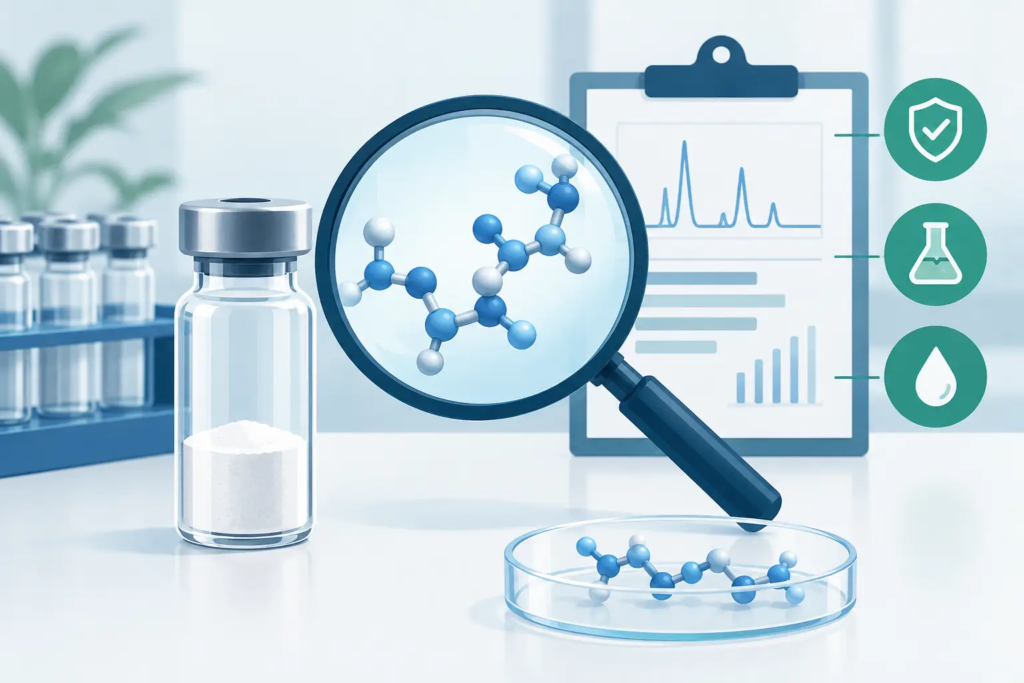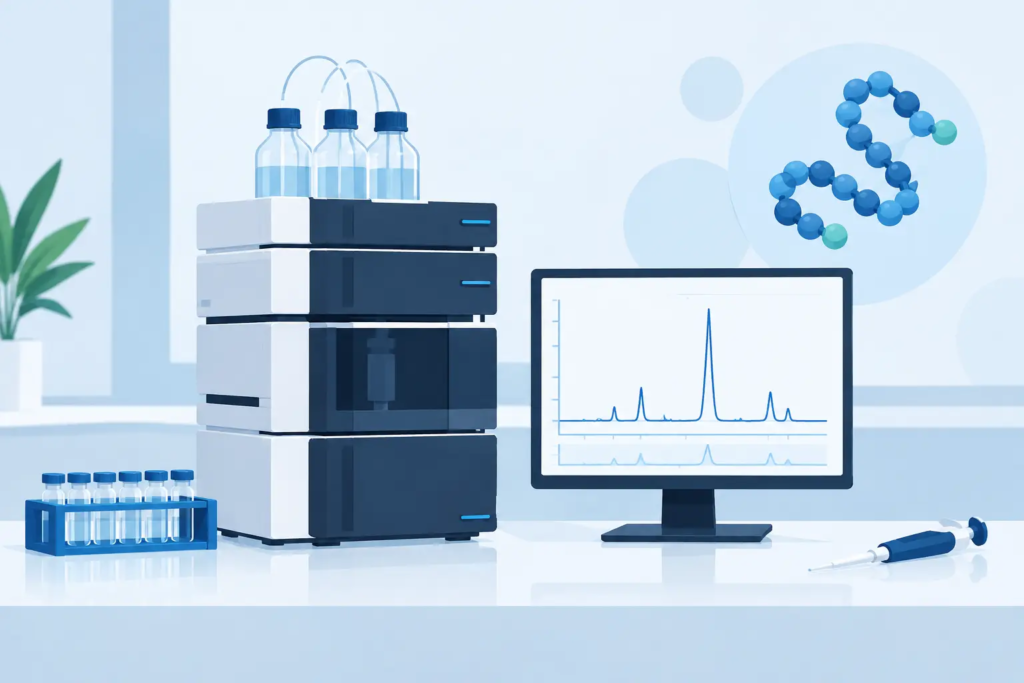
A peptide vial can look uniform while containing closely related impurities, truncated sequences, residual synthesis materials, or degradation products. HPLC purity testing gives research teams a documented way to separate those components, quantify the primary peak, and assess whether a material is suitable for its intended laboratory workflow.
For research procurement, a stated purity percentage is only useful when it is supported by batch-specific analytical documentation. A Certificate of Analysis, chromatogram, and supporting identity data help researchers evaluate what was tested, how the result was reported, and whether the available material aligns with their internal quality requirements.
What HPLC Purity Testing Measures
High-performance liquid chromatography, commonly called HPLC, separates compounds based on how they interact with a stationary phase inside a chromatography column and a liquid mobile phase moving through it. For peptides, reversed-phase HPLC is commonly used because it can distinguish the target sequence from many process-related and degradation-related components.
As the sample elutes from the column, a detector records a response over time. The resulting chromatogram displays peaks at specific retention times. Under a defined method, the principal peak is generally associated with the intended peptide, while additional peaks may indicate detectable impurities or related species.
Purity is often reported as area percent. In simple terms, the laboratory compares the integrated area of the main peak with the total integrated area of all reportable peaks. If the main peak represents 99 percent or more of the integrated chromatographic area, the material may be reported as greater than 99 percent pure by that method.
That wording matters. Area percent is a chromatographic measurement, not a universal statement that every molecule in the vial has been individually identified. It reflects the method, detector, integration settings, sample preparation, and reporting criteria used for that batch.
Why a Purity Number Alone Is Not Enough
A purity claim without a chromatogram or batch documentation leaves critical questions unanswered. Researchers should be able to determine whether the report corresponds to the actual lot being purchased, whether the sample was tested after manufacture or from retained inventory, and whether the method clearly identifies the main peak.
The chromatogram provides context that a standalone percentage cannot. A clean, dominant primary peak with low-level secondary peaks is generally easier to assess than a report that lists only a number. Peak shape also has value. Broad, split, tailing, or poorly resolved peaks can complicate interpretation and may warrant further review depending on the compound and analytical method.
HPLC also does not confirm molecular identity by itself. Two compounds can occasionally produce similar retention behavior under a particular method. That is why HPLC results are best reviewed alongside mass spectrometry verification. HPLC supports purity assessment, while mass spectrometry helps confirm that the observed molecular mass is consistent with the intended compound.
For peptide researchers, this combined documentation is more meaningful than either result alone. It helps establish a practical chain of evidence: the expected mass is present, the target component is the dominant chromatographic peak, and the batch is traceable to its associated records.
How to Read an HPLC Chromatogram
Start with the sample and batch details. A useful report identifies the compound, lot or batch number, test date, and analytical method or conditions. If the vial label, product record, and COA do not correspond, the report cannot provide reliable batch assurance.
Next, identify the main peak. The chromatogram should show its retention time and integrated area. The reported purity calculation should be understandable from the peak table or result summary. Researchers should also check whether small peaks are visible before or after the main peak, particularly if the intended application is sensitive to related peptide sequences or low-level contaminants.
Detector selection affects how the chromatogram should be interpreted. UV detection is widely used for peptides because peptide bonds and aromatic residues absorb ultraviolet light. However, UV response can vary among compounds. A peak area percentage therefore describes detector response under the stated conditions, rather than an absolute mass balance of every component.
Method conditions also matter. Column chemistry, mobile-phase composition, gradient profile, flow rate, temperature, wavelength, and injection volume can all influence separation. A chromatogram is most useful when it is generated using a suitable, consistent method and when the supplier can provide documentation tied to the exact batch.
Resolution and Peak Separation
A high reported purity result is stronger when the primary peak is well separated from nearby peaks. Resolution refers to how distinctly two adjacent components are separated. If peaks overlap, integration software may have difficulty assigning their areas accurately, especially when one component is present at a low level.
This does not mean every chromatogram must have a perfectly empty baseline. Complex peptides may produce minor related substances, and method development involves practical trade-offs. The key question is whether the method adequately separates the principal component from relevant impurities for the material being evaluated.
Reported Purity Versus Assay
Purity and assay are related but different measurements. HPLC area purity estimates the relative proportion of the main chromatographic component. Assay evaluates how much analyte is present relative to a reference or expected content, often using a validated quantitative approach.
For lyophilized research peptides, additional factors can influence net peptide content, including residual water, counterion content, salts, and handling conditions. A material can show a high HPLC purity result while its total peptide content by mass requires separate consideration. Research teams should avoid treating purity percentage and net content as interchangeable values.
Common Sources of Peptide Impurities
Peptide synthesis is a multistep process, and related substances can arise at several stages. Deleted sequences, incomplete coupling products, sequence truncations, protecting-group remnants, and racemization-related variants may occur during synthesis. Cleavage and purification steps can introduce additional process-related materials if controls are insufficient.
Storage and handling can also affect a peptide after production. Oxidation, deamidation, hydrolysis, aggregation, and other degradation pathways depend on sequence characteristics, moisture exposure, temperature, light, and repeated handling. The appropriate storage conditions should be followed for each material, and unnecessary temperature cycling should be avoided.
A high-quality supplier does not imply that every peptide behaves identically. Some sequences are inherently more challenging to synthesize, purify, or store. The right standard is not simply a broad claim of quality, but transparent, lot-specific evidence that enables researchers to assess the batch in context.
Building HPLC Review Into Procurement Controls
For organizations maintaining purchasing and laboratory records, HPLC documentation should be reviewed before material is introduced into a study. Establishing that practice early can reduce uncertainty later, particularly when a project requires comparison across lots or repeat orders.
A practical review process typically confirms four points: the COA identifies the correct compound and batch, the HPLC result reports a defined purity outcome, the chromatogram supports the reported result, and mass spectrometry or equivalent identity data is available. When the project demands greater analytical confidence, researchers may also request information on test conditions, impurity profiling, or independent third-party testing.
Supplier consistency matters as much as a single favorable report. Documented quality controls, accessible batch records, appropriate packaging, and dependable fulfillment all affect whether a compound can be sourced repeatedly without introducing avoidable variability into research workflows.
Questions to Ask Before Purchasing
Before selecting a research peptide supplier, ask whether the reported HPLC result is batch-specific and whether a chromatogram is available for review. Confirm that identity verification accompanies the purity claim, rather than assuming a single test answers both questions.
It is also reasonable to ask how the material is stored, how lot records are maintained, and whether documentation is readily available before or with the order. For time-sensitive laboratory work, inventory status and dispatch procedures deserve the same attention as the analytical result. A delayed or undocumented replacement batch can disrupt a study even when the original material met specifications.
Products should be handled only according to their documentation and applicable laboratory procedures. Research compounds are sold strictly for laboratory research use only and are not intended for human or veterinary use, diagnosis, treatment, injection, ingestion, or consumption.
A Better Standard for Research Confidence
HPLC purity testing is not a marketing badge. It is one part of a quality record that should be traceable, interpretable, and relevant to the batch in hand. When researchers review chromatograms alongside identity data, COAs, storage guidance, and lot information, they are better positioned to make procurement decisions based on evidence rather than assumptions.
The most useful question is not merely whether a supplier advertises a high purity percentage. It is whether the documentation gives your laboratory enough clarity to receive, record, store, and use the material with appropriate scientific controls.