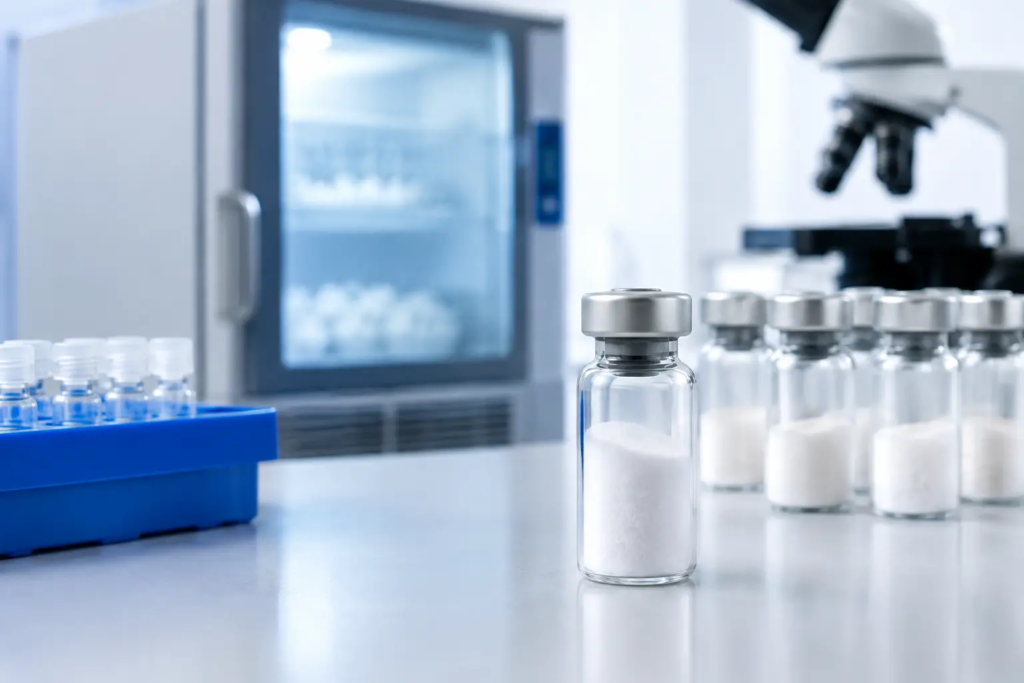
A peptide can arrive with a strong HPLC result, verified mass, and a complete Certificate of Analysis, then lose practical value through avoidable storage errors. Lyophilized peptide storage temperature is therefore not a minor receiving-room detail. It is part of the chain of control that protects a documented research material between shipment, inventory, and experimental use.
For research-use-only peptides, the correct temperature is the one specified on the product label, accompanying documentation, or supplier handling guidance for that specific material. Sequence, molecular size, counterion, formulation, residual moisture, and intended storage duration can all affect stability. A general temperature rule is useful only until it conflicts with the product-specific instruction.
Lyophilized Peptide Storage Temperature Starts With Documentation
Lyophilization removes water under controlled conditions, producing a dry peptide cake or powder that is generally more stable than the same material in solution. It does not make the material insensitive to temperature, moisture, oxygen, light, or handling. The objective is to keep the vial in the condition in which it was tested and documented.
For many lyophilized research peptides, frozen storage at approximately -20°C is commonly used for longer-term retention. Some materials may require colder storage, including approximately -80°C, particularly where the supplier specifies it or where extended retention is planned. Refrigerated storage at 2-8°C may be acceptable for certain short-term workflows, but it should not be treated as a default long-term solution without written support from the product documentation.
This is why procurement records should retain more than a catalog name. Record the lot or batch number, receipt date, stated storage condition, expiration or retest date where supplied, and the associated COA. A temperature target without lot-level traceability is incomplete laboratory control.
Do not substitute assumptions for the label
Storage instructions from unrelated peptides, articles, or forums may not apply to the material in hand. Two peptides can look similar on paper while differing in formulation or handling requirements. When documentation calls for a specific temperature range, follow that range rather than applying a broad rule such as “all peptides go in the freezer.”
If a vial arrives warm, damaged, wet, or without the expected documentation, quarantine it from active inventory while the issue is reviewed. Do not infer that a product remains within specification solely because the vial appears intact. Visual inspection can reveal obvious issues, but it cannot confirm identity, purity, or degradation state.
Temperature Control Is Also Moisture Control
The greatest handling risk with a cold lyophilized vial is often condensation. A vial removed directly from a refrigerator or freezer can collect atmospheric moisture when opened before it reaches room temperature. That moisture can enter the container, disturb the dry state, and create a variable that is difficult to reconstruct later.
Keep the vial tightly sealed and allow it to equilibrate to room temperature before opening. The exact equilibration time depends on vial size, packaging, and storage temperature. The operational principle is straightforward: do not open a cold vial in humid room air.
After dispensing, reseal the container promptly. Avoid leaving the vial uncapped on the bench while preparing other materials. If the original packaging includes a secondary barrier or desiccant, preserve it when consistent with the supplier’s instructions. Repeated exposure to ambient humidity can be more damaging than a single well-controlled transfer.
Light is another relevant variable for photosensitive materials. Where product documentation calls for light protection, retain the vial in its supplied protective packaging or use an appropriate opaque secondary container. This is especially relevant when samples are stored near transparent freezer doors or routinely handled under bright laboratory lighting.
Practical Storage Controls for Laboratory Inventory
A reliable peptide storage program does not require unnecessary complexity. It requires defined locations, controlled access, documented conditions, and a process that reduces handling events.
Use a monitored refrigerator or freezer appropriate to the specified storage range. Temperature logs should be reviewed at a frequency that fits the laboratory’s quality system and the material’s criticality. A display reading alone is not a complete control. Consider calibrated monitoring, alarms, backup power planning, and documented response procedures for temperature excursions.
Place vials in clearly labeled secondary containment rather than loose in a freezer drawer. Organize inventory so personnel can retrieve a sample without searching through multiple boxes. Every additional minute with a door open increases temperature fluctuation for the entire compartment, not just the vial being retrieved.
For valuable or limited-quantity materials, segregate working inventory from retained reference stock. A primary vial that is accessed repeatedly experiences more risk than one stored undisturbed. Where the product format and laboratory procedure allow, a controlled aliquoting plan after reconstitution may reduce repeated access to a single preparation. That plan must account for the stability of the peptide in solution, which is separate from the stability of the lyophilized material.
Avoid Repeated Temperature Cycling
Repeated transitions between cold storage and room temperature add unnecessary uncertainty. In the dry state, a peptide may tolerate brief handling, but repeated cycling can increase condensation risk and complicate an investigation if later results are inconsistent.
The practical answer is to plan before removing a vial from storage. Confirm the experiment, materials, and documentation are ready. Retrieve only the vial required for the immediate procedure, and return unopened material to its designated environment as soon as possible.
Avoid moving inventory between storage units without a reason and a record. A temporary relocation during maintenance, an alarm event, or a power interruption should be documented with the time out of range, observed temperature if available, and disposition decision. For regulated or high-value workflows, the supplier may be able to advise whether a specific excursion warrants additional evaluation, but the laboratory remains responsible for its own material-control decision.
Reconstitution changes the storage question
Once a lyophilized peptide is reconstituted, the original storage recommendation may no longer apply. Solvent composition, pH, concentration, container material, headspace, light exposure, and microbial controls can all affect solution stability. Do not assume that a dry powder’s freezer guidance establishes an acceptable hold time for a prepared solution.
Document the diluent, concentration, preparation date, preparer, and storage condition. Use laboratory-grade reagents appropriate to the validated or intended research workflow. If bacteriostatic water or another diluent is selected, that choice does not independently establish peptide compatibility or solution stability.
Prepared solutions should be treated under their own written handling plan. Where no stability data are available, a conservative approach is more defensible than extending storage based on convenience. Research materials sold strictly for laboratory research use only are not intended for human, veterinary, diagnostic, therapeutic, injection, ingestion, or consumption purposes.
What to Do After a Temperature Excursion
Not every excursion means a peptide has failed, and not every apparently normal vial remains within specification. The right response depends on the product-specific storage requirement, duration and severity of the event, vial condition, and the needs of the research program.
Start with a factual record. Identify the material, lot number, prescribed condition, known time outside the range, maximum or minimum temperature if available, and whether the container remained sealed. Hold the material from routine use while the event is assessed. Do not discard documentation or replace it with an undocumented assumption that the compound was unaffected.
For critical work, retain an unaffected control lot or reference material when feasible. If the investigation requires confirmation, analytical testing such as HPLC and mass spectrometry may help assess a retained sample, provided the method and acceptance criteria are suitable for the question being asked. A prior COA confirms the tested release batch, not the condition of a vial after an undocumented handling event.
A Short Receiving Checklist
When a shipment arrives, verify the product identity, quantity, lot number, physical condition, and expected supporting documentation before placing material into inventory. Review the stated storage requirement, move the sealed vial to the correct controlled environment promptly, and record its location.
This receiving step is where fast fulfillment and laboratory discipline meet. Rapid dispatch supports research continuity, but the receiving laboratory completes the quality chain by ensuring the material is stored correctly from the moment it is accepted.
A clear storage instruction, an intact temperature record, and a traceable batch file give researchers something more useful than a vague claim of “proper handling.” They create a defensible basis for deciding whether a lyophilized peptide is ready for the next stage of controlled laboratory work.