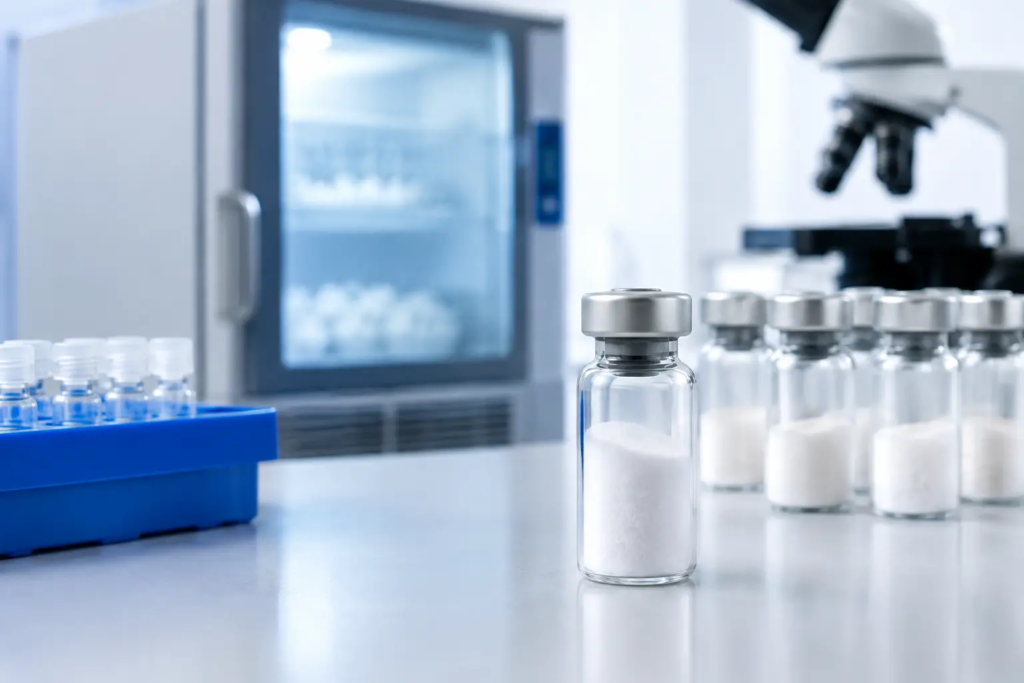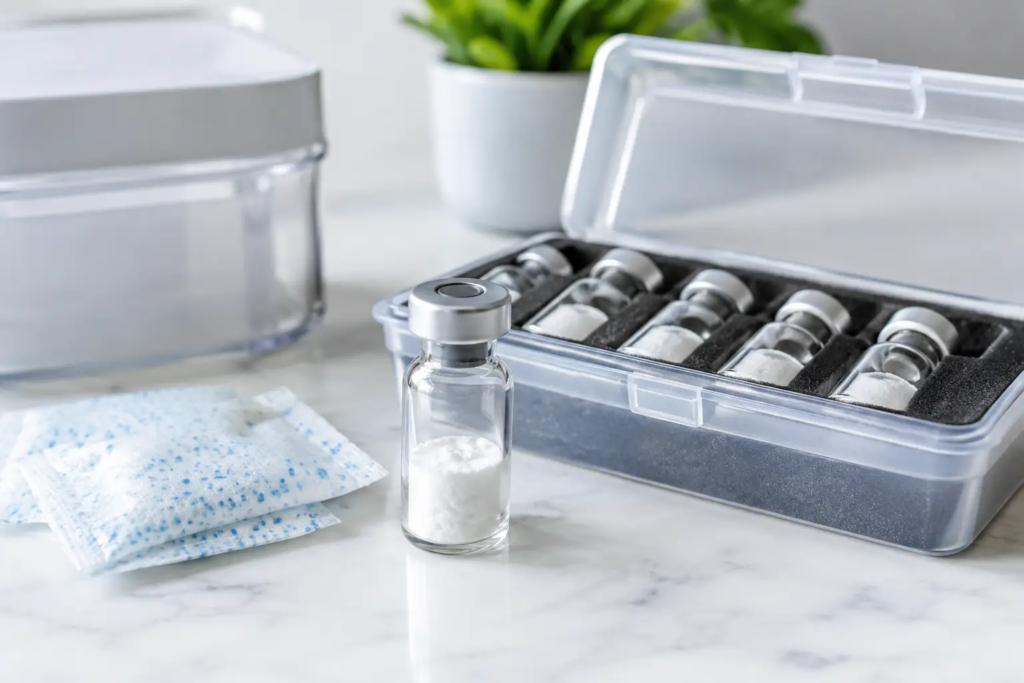
A lyophilized peptide can arrive with a strong Certificate of Analysis, verified identity, and high reported purity, then lose practical value through one avoidable handling failure: repeated exposure to humid air. To protect peptides from moisture, laboratories need more than a refrigerator or freezer. They need a controlled process from receipt through aliquoting, use, and inventory return.
Moisture control is not only a storage issue. It is a traceability issue. When a research material has been independently characterized by HPLC and mass spectrometry, the laboratory's storage and handling practices should help preserve the condition of the documented material. Poor humidity control introduces uncertainty that cannot be corrected by the original batch report.
Why moisture matters for lyophilized peptides
Lyophilization removes water to improve the stability and handling profile of many research peptides. That dry state is useful, but it is not permanent once the vial is exposed to ambient conditions. Peptides can absorb moisture from the air, particularly when a cold vial is opened before it has equilibrated to room temperature.
Water uptake may affect physical appearance, including powder clumping or changes in cake structure. More importantly, added moisture can increase the opportunity for chemical degradation pathways and can make repeat handling less predictable. The degree of risk depends on the peptide sequence, formulation, vial closure, storage temperature, humidity, and duration of exposure. There is no single storage rule that applies identically to every compound.
For research teams, the operational point is straightforward: minimize unnecessary contact between lyophilized material and humid laboratory air. Record the conditions that matter, especially when material supports repeat experiments or long-running projects.
Protect peptides from moisture before opening the vial
The highest-risk moment is often not long-term storage. It is the transition from cold storage to the bench. A vial removed from a refrigerator or freezer may be cooler than the surrounding air. If opened immediately, condensation can form on or near the container as the temperature equalizes.
Keep the vial sealed inside its secondary packaging while it reaches room temperature. The appropriate equilibration time will vary with package size, storage temperature, and laboratory conditions, but the principle remains the same: allow the unopened container to warm before breaking the seal. This reduces the chance that humid air contacts a cold vial.
Avoid leaving product on an open bench while preparing other materials. Plan the work first: confirm the protocol, prepare required equipment, label receiving tubes, and verify the appropriate laboratory-grade diluent before opening the peptide container. A short, deliberate handling window is preferable to repeated starts and stops.
If the material arrives with storage instructions on the label, product page, or batch documentation, those instructions should take priority. Product-specific guidance accounts for characteristics that generic peptide storage advice cannot capture.
Use storage systems designed for dry, stable conditions
Cold storage can slow degradation, but cold storage alone does not guarantee low moisture exposure. Every storage system should be evaluated for temperature stability, door-opening frequency, frost accumulation, and the way vials are packaged inside it.
For unopened lyophilized material, retain the original vial and closure whenever possible. Store it in a sealed secondary container that provides physical protection and limits ambient-air exchange. A properly maintained desiccant system may be appropriate within that secondary container, provided it is separated from the vial, monitored, and replaced according to laboratory procedure.
A practical moisture-control setup typically includes the following:
- A clearly labeled, sealed secondary container for the peptide vial or vial set
- A suitable desiccant or humidity-control component, maintained under documented replacement intervals
- Storage locations selected to reduce temperature cycling and frequent access
- Inventory records that identify receipt date, storage condition, vial status, and handling events
Desiccants are helpful, but they are not a substitute for a seal. A container that is repeatedly left open will quickly undermine the benefit of its humidity-control component. Likewise, a freezer that accumulates frost or undergoes frequent defrost cycles may create unstable conditions that warrant closer review.
Reduce exposure during sampling and reconstitution
Once a vial is open, time and technique matter. Work in a clean, dry area using equipment appropriate for the research protocol. Keep caps, stoppers, and vials protected from unnecessary contact and avoid handling that could compromise the closure or introduce contaminants.
If only part of a lyophilized vial is required, consider whether the research plan can be structured around single-use units or preplanned portions. This approach may reduce repeated opening cycles, although it must be balanced against material availability, experimental scale, and the risk of introducing error during aliquoting. The best approach depends on the study design and the amount of material required.
Reconstitution changes the storage question. Once a peptide is in solution, moisture is no longer the variable to control because water is intentionally present. At that point, attention shifts to diluent suitability, concentration, container compatibility, microbial control where applicable to the research workflow, freeze-thaw exposure, and the compound-specific stability profile. Do not assume that storage guidance for the lyophilized form applies to a reconstituted solution.
Use only a diluent that is appropriate for the documented laboratory protocol and the compound under study. Record the diluent, concentration, preparation date, operator, and storage location. This information supports repeatability and helps distinguish a material issue from a preparation issue if results vary later.
Watch for warning signs, but do not rely on appearance alone
Visible changes can justify investigation. Clumping, loss of a uniform lyophilized cake, apparent dampness, damaged seals, or unexplained residue around the closure may indicate that a vial experienced unsuitable conditions. A temperature excursion, a package left unsealed, or visible condensation should also be documented.
However, a vial that looks normal is not automatically unchanged. Many forms of degradation are not visible. That is why storage discipline should complement, rather than replace, supplier documentation and analytical verification. A COA establishes information about the tested batch at release. It does not certify every handling event after delivery.
When exposure is suspected, quarantine the material from active use until the laboratory's internal review is complete. Record the batch or lot identifier, observed condition, suspected event, dates, storage history, and any related experiment identifiers. Depending on the research significance of the material, an organization may decide to replace the vial, perform additional analytical evaluation, or exclude it from critical work.
Build moisture control into receiving and inventory procedures
The most dependable systems do not rely on memory. Establish a receiving procedure that directs personnel to inspect packaging, confirm the product identifier and batch documentation, and transfer material promptly to the designated storage condition. If shipping conditions or package integrity raise questions, document them before the material enters routine inventory.
Inventory records should distinguish unopened, opened, and reconstituted status. This is more useful than a single generic storage label because each state has different handling considerations. A vial that has been opened multiple times should not be treated as operationally identical to a sealed vial from the same batch.
For teams purchasing research peptides regularly, consistency starts with sourcing. Materials such as those supplied by SKO Compounds are sold strictly for laboratory research use only and supported by product-specific documentation. That documentation is most valuable when matched by equally disciplined receiving, storage, and use records inside the laboratory.
A controlled process protects the research record
Moisture management is a small part of the workflow, but it has outsized value when experiments depend on consistent material handling. Keep vials sealed until they have equilibrated, limit open-bench exposure, use dry secondary storage, and document deviations rather than explaining them away after the fact.
A well-preserved peptide vial supports more than orderly storage. It helps preserve the connection between the tested batch, the experimental record, and the confidence researchers need to interpret their results.