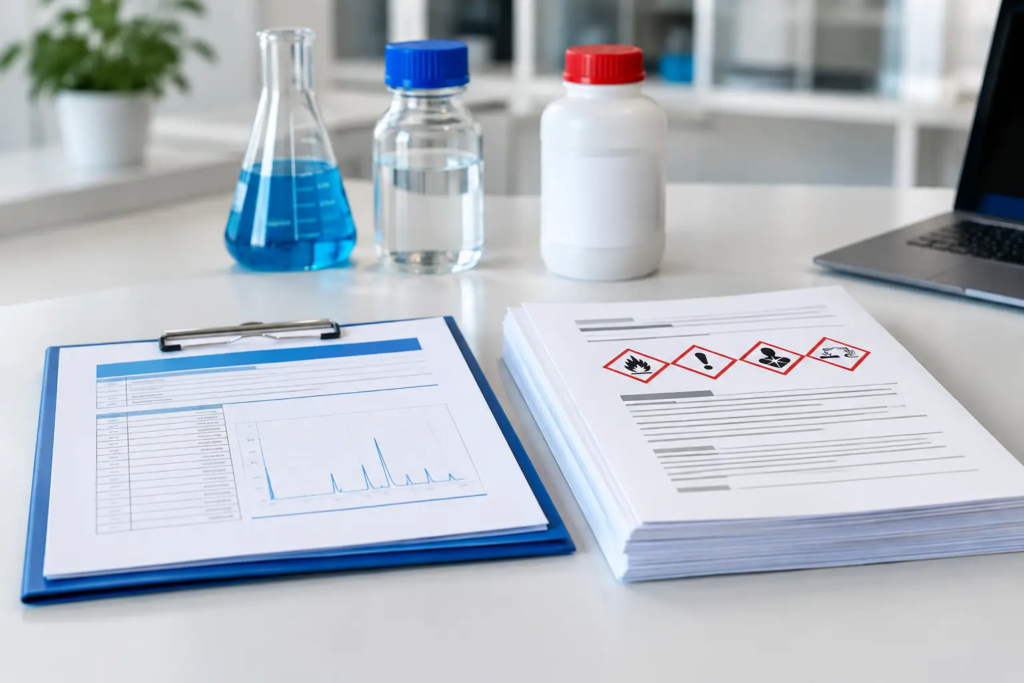
A vial labeled with a peptide name and purity claim is not, by itself, sufficient procurement evidence. Analytical verification gives a research team a documented basis for deciding whether a material is appropriate for its intended laboratory workflow. For lyophilized research peptides, that evidence should address identity, purity, detectable impurities, and the specific batch received.
For procurement teams, the practical question is straightforward: can the supplier show what the material is, how it was tested, and which results apply to this lot? A well-documented answer reduces uncertainty before a compound enters inventory, is reconstituted for permitted laboratory work, or is included in an in-vitro or pre-clinical protocol.
What Analytical Verification Establishes
Analytical verification is the process of using defined laboratory methods to confirm that a material aligns with its stated specifications. It is not a single document or a single instrument result. For research peptides, the strongest verification package combines complementary methods because each method answers a different question.
High-performance liquid chromatography, commonly reported as HPLC, is used to assess purity and separation behavior. A chromatogram can show the principal peak associated with the target material and reveal detectable related substances, synthesis byproducts, degradation products, or other impurities. When a supplier advertises purity above 99%, the HPLC documentation should support that claim for the reported batch.
Mass spectrometry provides a separate identity check by measuring molecular mass. For peptides, the expected mass is tied to the stated sequence and chemical form. A mass result that corresponds to the expected molecular weight provides meaningful evidence that the primary analyte is consistent with the label. HPLC may indicate how cleanly a sample separates, while mass spectrometry helps establish what the principal component is. Neither result should be treated as a substitute for the other.
Impurity profiling adds necessary context. A high reported purity percentage is useful, but researchers also need to understand whether the report identifies relevant secondary peaks or provides an impurity threshold. The appropriate level of detail depends on the study design, the analytical sensitivity required, and whether the material will be compared across multiple experiments or lots.
Why a Certificate of Analysis Must Be Batch-Specific
A Certificate of Analysis, or COA, should connect analytical results to the exact lot being purchased or held in laboratory inventory. A generic specification sheet can describe a supplier's intended standards, but it does not verify the composition of an individual batch. Batch identifiers, test dates, analytical method references, and reported results make the documentation traceable.
This distinction matters when a research group needs repeatability. If a result later requires review, the team should be able to identify the material used, locate the corresponding COA, and compare it with other lots. Without that chain of documentation, a purity claim becomes difficult to audit internally.
A useful COA typically identifies the compound, lot number, test method, reported purity, mass result, and release status. Depending on the supplier and material, it may also include storage guidance, appearance, quantity, retest information, chromatograms, or instrument data. Documentation formats vary, but the critical point is that the information is specific enough to support laboratory records.
Independent third-party testing can provide additional confidence because the testing function is separated from routine production and fulfillment. That does not mean every laboratory uses identical methods, reporting thresholds, or sample preparation procedures. Researchers should still review what was tested, which method was used, and whether the report clearly matches the lot under consideration.
Reading HPLC Results With Appropriate Context
An HPLC purity result is often the first figure a purchaser sees, but it deserves more than a quick glance. The reported percentage depends on the method, detector, integration approach, and how peaks are assigned. A 99% result is meaningful when it is paired with clear batch identification and an interpretable chromatogram, not when it appears as an unsupported marketing statement.
Purity also does not answer every question about material suitability. HPLC is particularly helpful for assessing chromatographic purity, but it may not fully characterize every possible contaminant or confirm sequence-level identity. For that reason, it is best evaluated alongside mass spectrometry and the complete documentation package.
Researchers working with low-concentration assays or highly sensitive readouts may need to set acceptance criteria beyond a general purity target. In other cases, a documented purity standard above 99% may be appropriate for the planned non-clinical work. The right threshold depends on the protocol, not on a universal claim.
What Mass Spectrometry Adds
Mass spectrometry is especially valuable when names, catalog labels, and visual appearance are not enough to establish identity. Lyophilized peptides often appear as similar powders, and appearance is not an analytical identity test. A mass spectrum provides evidence tied to the expected molecular mass of the analyte.
Researchers should recognize that mass confirmation is not the same as full structural characterization. Isomers, sequence-related variants, salts, adducts, and method limitations may require additional analytical approaches depending on the material and research objective. The appropriate question is whether the reported method is sufficient for the stated identity claim and intended laboratory use.
Analytical Verification in the Procurement Process
Verification works best when it is part of the purchasing process rather than a document requested after delivery. Before placing an order, research teams can establish a short internal standard for acceptable supplier documentation. This helps avoid delays when a study requires material release, lot traceability, or quality review.
Start by confirming that the supplier makes batch-level COAs accessible and that the documents include a meaningful connection between the product name, lot number, and analytical results. Next, confirm that HPLC and mass spectrometry are part of the verification approach where applicable. Finally, check that the stated purity standard is explicit rather than implied.
Operational controls matter as well. A verified material can still be compromised by poor inventory handling, unclear storage instructions, or delayed fulfillment. For lyophilized research compounds, laboratories should follow the supplier's storage guidance, maintain their own receipt and storage records, and minimize avoidable exposure to unsuitable conditions during handling. Reconstitution, where permitted by a laboratory protocol, should use suitable laboratory materials and documented procedures.
Fast dispatch is valuable when a lab is managing a schedule, but speed should not replace documentation review. The strongest suppliers provide both: accessible analytical records and dependable order handling. At SKO Compounds, this approach centers on product-specific documentation, third-party verification, and research-use-only handling expectations.
Common Documentation Gaps to Avoid
A few warning signs should prompt additional review. A purity percentage with no associated test method provides limited value. A COA that does not display a lot number cannot reliably be tied to the received material. A mass result without an expected value or clear compound identification may be hard to interpret. And a generic report reused across unrelated products or batches does not provide meaningful traceability.
Researchers should also be cautious about overstating what any one report proves. Analytical verification supports informed material selection and batch control. It does not establish clinical safety, therapeutic suitability, human use suitability, or performance in a particular assay. Research peptides and associated materials must be sold and handled strictly for laboratory research use only, not for human, veterinary, diagnostic, therapeutic, injection, ingestion, or consumption purposes.
Build Verification Into Your Laboratory Record
The most useful quality documentation is documentation that remains usable after the order is received. Save the COA with the purchase record, record the lot number in the laboratory inventory system, and associate the lot with applicable experiments or retained samples. If a new batch is introduced, review its analytical documentation rather than assuming it is interchangeable with the prior lot.
That discipline creates a clearer path when results need to be reproduced, compared, or investigated months later. Before the next peptide purchase, make the COA and the supporting analytical data part of the release decision, not an afterthought.