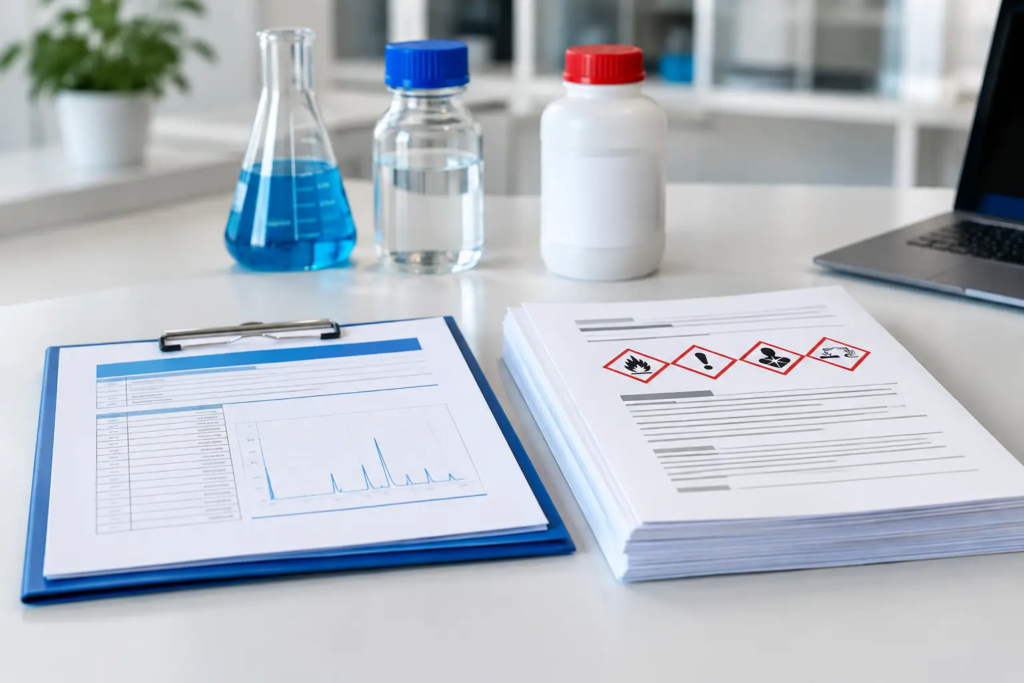
A purchase record may show a product name, a vial label may show a lot number, and a laboratory may hold an SDS on file. None of those items, by themselves, confirms that a specific peptide lot matches its stated identity and purity. The COA versus safety data sheet question matters because these documents answer different operational questions.
A Certificate of Analysis addresses the material that was tested. A Safety Data Sheet addresses the hazards, handling considerations, and emergency information associated with a chemical product. For research procurement, treating one as a replacement for the other creates an avoidable documentation gap.
COA versus safety data sheet: different questions
The simplest distinction is this: a COA is quality documentation, while an SDS is hazard communication documentation.
A Certificate of Analysis, often called a COA, ties analytical results to a defined product lot or batch. It helps a researcher assess whether the supplied material conforms to the stated specifications. For a lyophilized research peptide, that may include lot identification, purity results, molecular mass confirmation, chromatographic data, impurity information, and the analytical methods used.
A Safety Data Sheet, or SDS, communicates known or anticipated safety information. In the United States, the standardized 16-section SDS format supports OSHA Hazard Communication requirements and aligns with the Globally Harmonized System framework. It is designed to help laboratories establish appropriate storage, labeling, personal protective equipment, spill response, transport, and disposal procedures.
Neither document answers every question. A COA is not a safe-handling authorization, and an SDS is not evidence that a particular lot was analytically verified. Researchers need both when quality assurance and laboratory safety records matter.
What a COA verifies for a research compound
A useful COA begins with traceability. The product name, catalog reference where applicable, lot or batch number, test date, and report date should allow the document to be matched to the labeled material in hand. If a supplier provides a generic report with no batch-specific identifier, it cannot fully support lot-level verification.
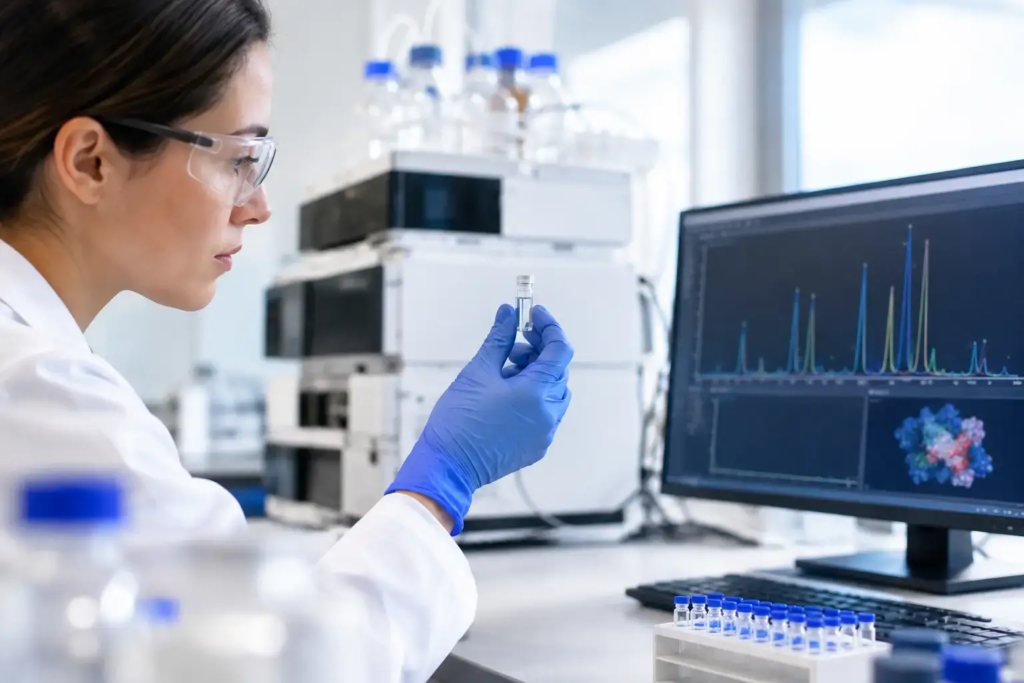
For peptides and other research compounds, identity and purity are commonly the primary review points. High-performance liquid chromatography, or HPLC, is frequently used to characterize purity and identify related peaks. Mass spectrometry is commonly used to verify that the observed molecular mass aligns with the expected compound identity. A strong report may also identify the method conditions, acceptance criteria, and reported result rather than offering a broad statement without supporting data.
At SKO Compounds, product-specific documentation and independent analytical verification are central to the quality-control process. When a product is advertised as independently verified for greater than 99% purity, the relevant COA should be reviewed as evidence for the stated lot and test method, not interpreted as a blanket claim for unrelated batches or materials.
How to read HPLC and mass spectrometry results
An HPLC purity percentage is meaningful only in context. It generally reflects the percentage area attributed to the principal peak under the stated chromatographic method. It does not automatically describe every possible contaminant, residual solvent, water content, counterion, endotoxin level, sterility attribute, or biological activity. Those characteristics require separate methods and specifications when they are relevant to a protocol.
Mass spectrometry adds a separate line of evidence. A reported mass consistent with the expected molecular weight supports identity confirmation, but it does not replace purity testing. Conversely, a high HPLC purity result does not independently prove molecular identity. The two methods are complementary, which is why researchers should value documentation that identifies both the test performed and the lot tested.
Researchers should also look for internal consistency. The lot number on the COA should match the vial or outer packaging. The material description should match the purchased compound. Dates should be plausible, and results should be presented clearly enough to support procurement records. A report that cannot be connected to the actual material should be treated as incomplete documentation.
What a safety data sheet tells the laboratory
An SDS is built for risk communication. Its sections typically cover identification, hazard identification, composition, first-aid measures, fire-fighting measures, accidental-release measures, handling and storage, exposure controls, physical and chemical properties, stability, toxicology, disposal, transport, and regulatory information.
For a laboratory team, the practical value is immediate. The SDS helps determine how the material should be stored before use, what controls may be appropriate during handling, what to do if a container is compromised, and how the material should enter the facility's waste process. These decisions belong in the laboratory's own safety procedures and risk assessment.
An SDS may apply to a product category or formulation and may not contain a lot-specific analytical result. That is normal. Its purpose is not to certify the purity of an individual vial. Similarly, an SDS should not be read as a statement that a research compound is approved for a particular experimental, diagnostic, therapeutic, veterinary, or consumer use.
Why the revision date matters
SDS documents can be updated as hazard classifications, supplier information, composition details, transport guidance, or regulatory language change. Laboratories should retain the current revision that corresponds to their inventory controls and review it when a new shipment or updated document is received.
The SDS also needs to be usable in the setting where the material is handled. A research organization may have requirements that go beyond a supplier document, including site-specific PPE rules, ventilation requirements, chemical hygiene plans, training procedures, and waste vendor instructions. The SDS informs those controls; it does not replace them.
Why procurement teams should request both documents
The COA supports a quality decision before material enters a study. The SDS supports a safety and compliance decision before material enters the laboratory workflow. Together, they create a more complete record of what the material is and how it should be managed.
This distinction is especially relevant for lyophilized research peptides. A researcher may need to verify the lot's HPLC purity and mass result before using it in an in-vitro or pre-clinical workflow. The same researcher or laboratory manager must also determine storage conditions, container handling, emergency procedures, and disposal controls. One document cannot do both jobs well.
A practical receiving process starts by matching the shipment label, purchase record, and COA lot number. The laboratory can then file the applicable SDS in its chemical inventory system, confirm storage conditions, and document any internal review required before the material is released for research use. Fast fulfillment does not reduce the need for this step. It makes organized receiving more valuable.
Documentation issues that deserve follow-up
Researchers should pause when documentation contains conflicting product names, missing lot numbers, unreadable chromatograms, unexplained purity claims, or reports that appear to apply to a different material. A purity percentage without a method, test date, or batch identifier provides limited procurement value.
It is also worth separating analytical quality from suitability for a specific protocol. A verified research compound may still be unsuitable for a particular assay if the protocol requires attributes not covered by the supplied COA, such as a defined salt form, moisture specification, microbial limit, or a validated concentration after reconstitution. The needed documentation depends on the experiment.
For the same reason, a COA should never be used to infer that a material is sterile, injectable, ingestible, or appropriate for human or veterinary use unless those specific properties and intended uses are explicitly established through appropriate regulated documentation. Research compounds are sold strictly for laboratory research use only and are not intended for human, veterinary, diagnostic, therapeutic, injection, ingestion, or consumption purposes.
A disciplined way to review incoming materials
Before accepting a research compound into active inventory, verify five points: the container identity matches the order, the COA lot number matches the container, the analytical results meet the needs of the planned work, the current SDS is available to the laboratory, and storage requirements are understood before the material is put away.
This review does not need to slow research down. It prevents a more expensive problem later, when an unexpected result cannot be traced to a defined lot, a missing chromatogram, or an undocumented handling condition. Clear records let researchers evaluate results with greater confidence and make repeat ordering more defensible.
The strongest procurement habit is to treat the COA as the evidence trail for material quality and the SDS as the working reference for laboratory safety. Keep both attached to the correct lot, and the next step in the research workflow starts on documented ground.